Abstract art has long offered artists a language beyond literal depiction, allowing the figure of the woman to move from representation into symbolism, gesture, memory, and structure. In the history of modern and contemporary art, the abstract painting of a woman often communicates cultural assumptions and emotional frameworks rather than physical likeness.
Many overviews of famous woman painting prioritize recognition over reflection, presenting canonical works without examining how abstraction reshapes female presence. This article follows a familiar survey format while correcting its limitations by expanding authorship, cultural scope, and conceptual depth.
This overview clarifies how abstraction redefines womanhood through form, process, and perspective rather than appearance.
Early modern abstraction did not eliminate the female body; it reorganized it. Cubism and Suprematism transformed women into intersecting planes, spatial rhythms, and formal systems. In works by Pablo Picasso and Kazimir Malevich, women functioned less as individuals and more as compositional anchors within evolving visual languages.
These famous female paintings often detached femininity from narrative context, prioritizing structure over lived experience. While visually radical, such abstraction positioned women as symbols rather than agents.
Early abstraction established visual innovation while confining women to structural roles within composition.

Mid-century abstraction reintroduced emotional intensity through gesture and material. Willem de Kooning complicated the abstract painting of a woman's face by merging figuration with aggressive mark-making, exposing tension between desire, fear, and representation.
While these works challenged traditional portraiture, they largely maintained a male-centered gaze. The woman’s body became a site of expressive conflict rather than self-definition.
Expressionist abstraction intensified psychological presence without substantially altering authorship or power dynamics.

When women artists engaged abstraction on their own terms, the language itself changed. Lee Krasner transformed gestural abstraction into rhythmic continuity rather than dominance.
Similarly, Joan Mitchell embedded memory and landscape into abstraction, emphasizing persistence and emotional duration over confrontation.
Female-authored abstraction centers perception and endurance rather than externalized form.
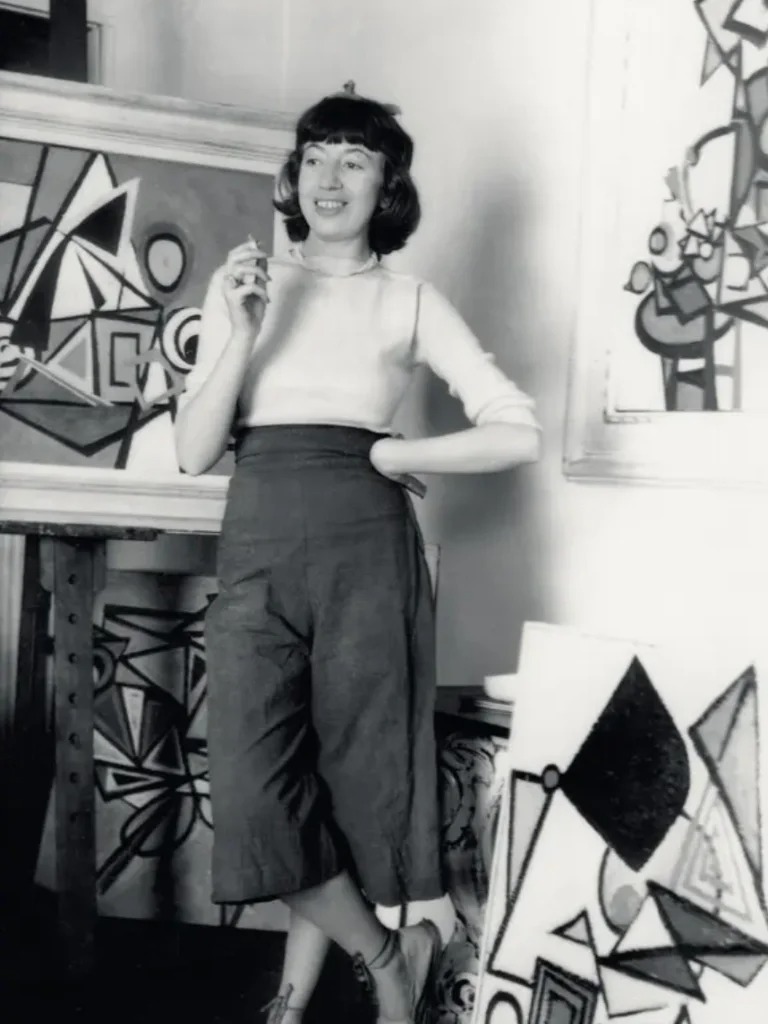

The face, once abstracted, becomes a conceptual threshold. Artists such as Joan Miró reduced facial features to signs and symbols, preventing stable identification. In these works, recognition remains partial, encouraging sustained viewing rather than instant emotional reading.
Unlike traditional portraiture, the abstract painting of a woman's face withholds narrative certainty. Viewers encounter structure first and emotion second.
Abstracted faces convert identity into an open visual field rather than a fixed image.

Abstraction often extends beyond image into process. While historically some practices incorporated female bodies as tools, this approach exposed imbalances between control and visibility.
By contrast, Maria Lassnig redirected attention inward, using abstraction to visualize bodily sensation rather than external appearance.
Material-based abstraction reveals how process can either reinforce or challenge bodily agency.

Contemporary abstraction increasingly addresses cultural specificity. Wangechi Mutu combines collage, paint, and fragmentation to examine gender through postcolonial identity and hybridity.
In this context, famous woman painting is defined by narrative complexity rather than stylistic recognition alone.
Global abstraction situates womanhood within historical and cultural memory rather than universality.

Today, abstraction accommodates contradiction. Contemporary artists integrate references to politics, technology, and personal history without resolving them into singular meaning. The woman abstract painting now functions as a layered structure rather than a visual statement.
This shift acknowledges that abstraction is not neutral, but shaped by context, authorship, and reception.
Contemporary abstraction defines womanhood through multiplicity rather than resolution.
Abstract paintings of women remain relevant because they resist closure. They avoid prescribing identity, allowing form and material to carry layered meaning. By expanding beyond canonical limitations, abstraction continues to reflect evolving understandings of gender without relying on depiction.
Abstraction sustains open interpretations of womanhood across time and culture.
At ArtPhiloso, abstraction is approached as an evolving visual language rather than a fixed historical style. The works presented on artphiloso.com engage with form, material, and spatial rhythm in ways that echo the open-ended nature of contemporary abstract painting.
For readers interested in original artworks that extend the dialogue around abstraction and perception, ArtPhiloso offers a carefully curated selection aligned with the themes explored in this article.
Hi, I’m Philo, a Chinese artist passionate about blending traditional Asian art with contemporary expressions. Through Artphiloso, my artist website, I share my journey and creations—from figurative painting and figure painting to floral oil painting and painting on landscape. You'll also find ideas for home decorating with paint and more.
